
FaithTech
FaithTech designs and manufactures programmable DC power supplies and electronic loads for energy, industrial, automotive, electronics, and aerospace applications.
Copyright © 2026 FaithTech
FaithTech designs and manufactures programmable DC power supplies and electronic loads for energy, industrial, automotive, electronics, and aerospace applications.
Copyright © 2026 FaithTech
An in-depth look at the core differences between unidirectional and bidirectional power supplies, helping engineers and procurement teams make the right call.
Related FaithTech resources: FTB9000.
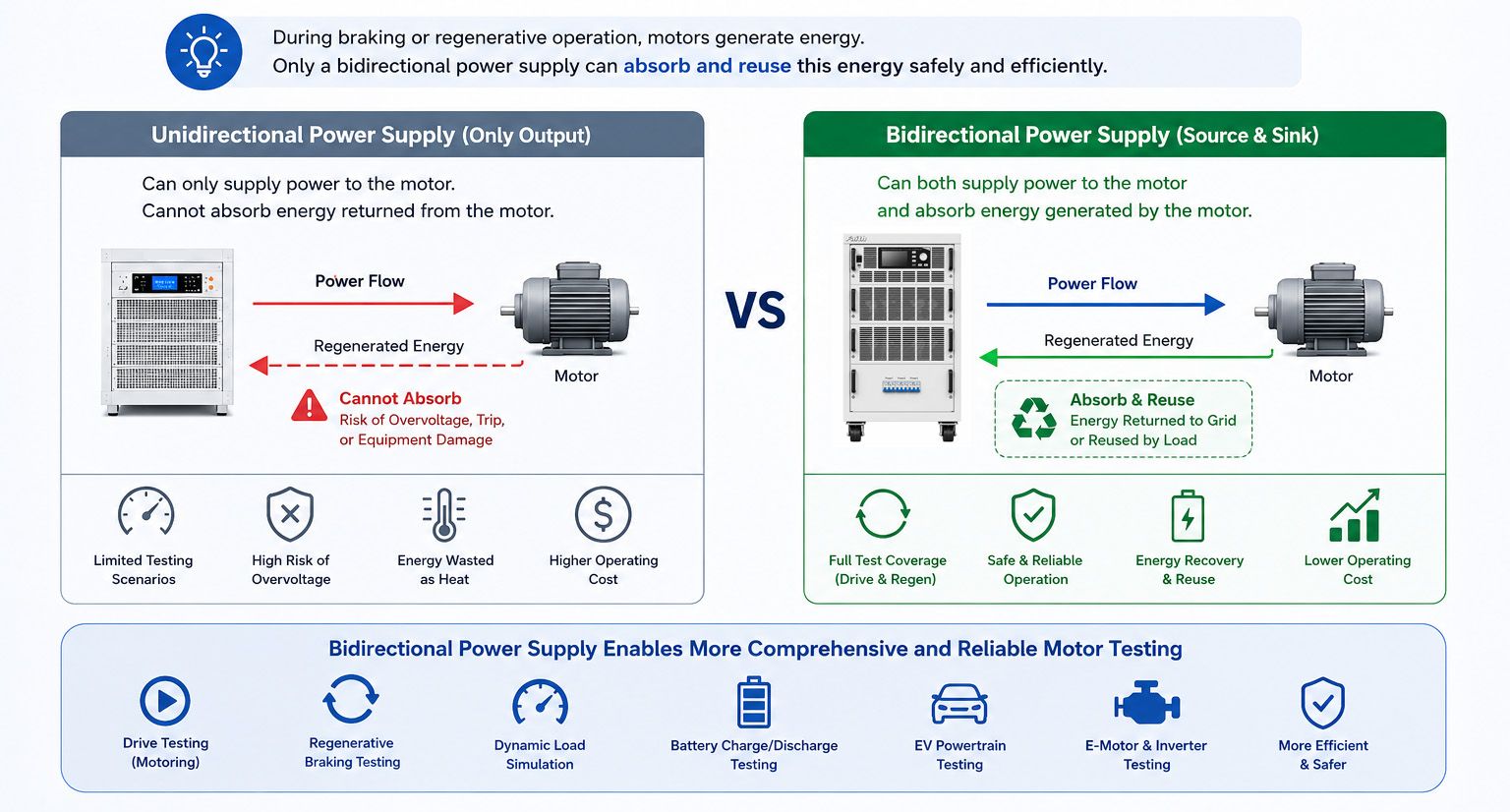
A test engineer recently shared a frustrating experience with us: a unidirectional DC power supply in his lab burned out in less than three days while performing braking tests on a servo motor. After they replaced the unit, the exact same thing happened. Upon troubleshooting, it turned out the issue wasn't the quality of the power supply, but a selection error—he was using a standard unidirectional power supply to test a motor that occasionally acts like a generator.
This scenario is surprisingly common in after-sales service. In this article, we'll break down the fundamental differences between unidirectional and bidirectional power supplies to help you understand exactly why bidirectional power supplies are the only safe bet for motor testing.
Under certain conditions, a motor shifts from consuming power to generating it, dumping energy back into the power supply. This usually happens during:
Core Logic: As long as the motor is decelerating or being back-driven, it acts as a generator feeding energy back to the DC bus. This energy must go somewhere, otherwise, a component in your setup will take the hit.
How a power supply handles this "back-fed energy" is exactly what separates unidirectional models from bidirectional ones.
Traditional unidirectional DC power supplies (non-regenerative) rely on a one-way conversion topology. Their internal circuits only allow current to flow from the grid to the load. They simply cannot process reverse current.
When a motor feeds current back, the energy rapidly builds up on the DC bus, causing a massive voltage spike. Without built-in protection, the power supply's internal components will succumb to overvoltage—triggering a sudden shutdown at best, or a total hardware burnout at worst.
Risk Warning: Unidirectional power supplies provide no "escape route" for a motor's back-fed energy. The resulting voltage surge is instant and unpredictable, easily destroying equipment during e-stops or sudden back-driving.
To force a unidirectional power supply to work in motor testing, engineers often hook up braking resistors (bleeder resistors) to literally "burn off" the excess energy. While feasible, this comes with major drawbacks:
Bidirectional DC power supplies (regenerative) feature an internal two-way DC/AC converter. They can push energy from the grid to the load (discharging) AND seamlessly absorb back-fed energy from the load, regenerating it back to the grid (charging/regenerating).
This means any reverse current generated by your motor is safely absorbed and recycled into usable AC electricity. No external braking resistors or heat sinks are needed.
| Feature | Unidirectional (+ Braking Resistor) | Bidirectional Power Supply |
|---|---|---|
| Handling Back-Fed Energy | Dissipated as heat | Regenerated to the grid (>90% efficiency) |
| Heat Generation | Severe; requires dedicated cooling | Minimal to zero |
| Continuous Braking Tests | High risk of burning out resistors | Fully supported, zero risk |
| E-Stops / Back-Driving | High risk of equipment damage | Naturally compatible |
| Setup Complexity | Complex wiring, extra accessories | Clean, plug-and-play |
| Energy Efficiency | 100% of regenerative energy wasted | Recycles power, lowering utility bills |
| Failure Rate | High (risks to both supply & resistor) | Very low, highly stable |
Motors are inductive loads. During startups, accelerations, e-stops, and braking, they can pull or push surge currents several times their rated value. If you match your power supply perfectly to the motor's nameplate rating, transient overloads will inevitably cause nuisance tripping or hardware failure.
Power Supply Rating ≥ 3 × Motor Rated Power (Never go below a 2X multiplier)
Here are our sizing recommendations based on your application:
It's true—bidirectional power supplies usually carry a 30% to 100% higher upfront price tag compared to standard unidirectional units. However, when you look at the Total Cost of Ownership (TCO), the narrative flips completely:
| Cost Factor | Unidirectional Setup | Bidirectional Setup |
|---|---|---|
| Initial Procurement | Power Supply + Braking Resistor + Cooling System | Bidirectional Power Supply (All-in-One) |
| Installation & Labor | Complex wiring, lengthy commissioning | Simple setup, ready immediately |
| Ongoing Electricity Bills | High (Braking energy lost entirely as heat) | Low (Energy regenerated to the grid) |
| Maintenance & Downtime | High (Resistors fail frequently) | Extremely low (Simplified system architecture) |
| Typical ROI on the Premium | — | Usually recovered within 12 months |
Especially in testing labs that run high-frequency, long-duration motor tests, the utility savings from grid regeneration are massive. You'll generally recoup the initial price difference in about a year.
Q: Can't I just get away with a unidirectional supply and a massive braking resistor?
A: Technically yes, but you're playing with fire. If your resistor is slightly undersized, or your lab's AC fails during an e-stop, you risk catastrophic damage to both the resistor and the power supply. For dynamic, high-inertia, or frequent braking tests, upgrading to bidirectional is the only way to eliminate this risk entirely.
Q: What kind of motors require bidirectional testing?
A: Any motor requiring DC power for dynamic testing, including BLDC (Brushless DC), PMSM (Permanent Magnet Synchronous Motors), servo motors, stepper motors, and especially EV traction motors and electric drive test benches.
Q: How efficient is the regeneration feature?
A: Modern bidirectional supplies convert reverse DC current into clean AC grid power with over 90% efficiency. It's night and day compared to the 0% efficiency of a thermal resistor.
Q: Do I absolutely have to buy a supply with 3x the motor's power rating?
A: 3x is the industry-standard safety net for heavy inertial loads and aggressive e-stops. If your testing profile is very gentle (slow ramps, no hard braking), you might get away with 2x, but never go below that. When in doubt, consult our engineering team before buying.
Q: What's the fastest way to know if I need a bidirectional supply?
A: You need one if your test includes ANY of the following: deceleration/braking profiles, motor power ≥ 6 kW, a back-to-back dynamometer setup, testing regenerative braking on a motor controller, or continuous braking endurance tests.
Motors generate reverse power: unidirectional struggles with it, while bidirectional profits from it. Always size at least 3x the rated power to keep your lab safe and your downtime zero.
These two rules— always opt for bidirectional in motor testing, and never skimp on the 3x power buffer—will save you from the vast majority of equipment failures and testing headaches.
Covering multiple power ranges with grid-tied regeneration, purpose-built for motor and EV drive testing. Contact our engineering team today for expert sizing advice and tailored solutions.
