

Precision Current Profiling for Modern IoT Edge Devices
As IoT sensor nodes shrink in size and expand in deployment scale, power efficiency has become a defining engineering constraint—not just for battery life, but for system reliability, thermal management, and long-term maintenance cost. Traditional electronic loads optimized for power supply or charger validation often lack the resolution and speed needed to capture microamp-level transitions across milliseconds or microseconds. The FT6200A series small power electronic load bridges this gap with its industry-leading 0.05mA minimum current resolution and 50kHz dynamic test capability—making it uniquely suited for characterizing real-world current behavior in energy-constrained edge devices.
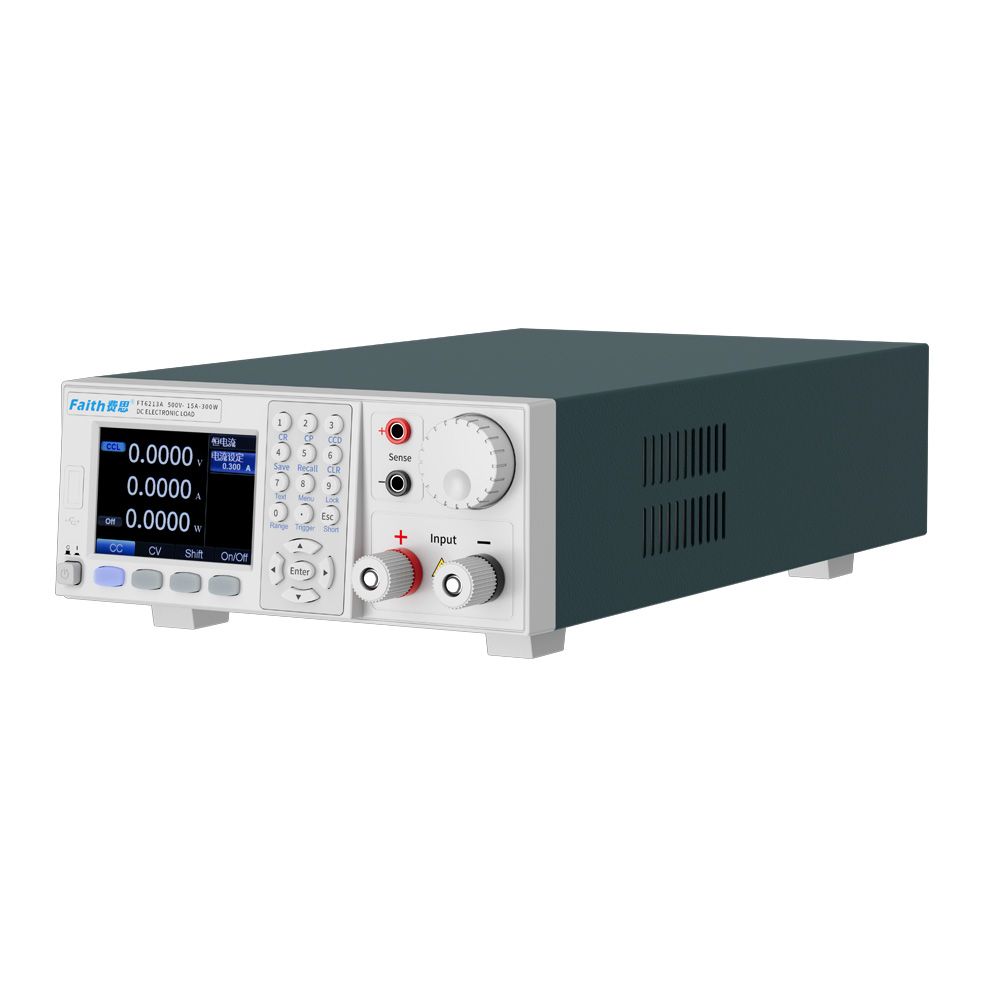
Unlike high-power loads that sacrifice low-end fidelity for range, the FT6200A delivers calibrated accuracy down to the sub-100µA regime: current measurement accuracy is (0.05% + 0.05%F.S.), and voltage resolution reaches 0.5mV. This enables trustworthy quantification of quiescent states, wake-up spikes, and intermittent communication bursts—critical data points that directly inform battery selection, firmware optimization, and lifetime estimation.
Capturing Sleep/Wake Cycles with Sub-Millisecond Fidelity
IoT sensor nodes spend >95% of their operational time in ultra-low-power sleep modes—often drawing <10µA—before waking briefly to sample sensors, process data, and transmit via BLE, LoRaWAN, or NB-IoT. These transitions involve complex timing dependencies: wake latency, ADC settling, radio initialization, and transmission ramp-up all contribute to non-linear current signatures. The FT6200A’s 50kHz dynamic mode supports sampling intervals as short as 20µs, allowing engineers to reconstruct full current waveforms across multi-phase wake sequences without aliasing or averaging artifacts.
Using the built-in load sequence editing function, users can define custom dynamic profiles matching actual firmware state machines—e.g., 5ms sleep at 2.3µA → 800µs wake ramp → 12ms active transmission at 18mA → return-to-sleep decay. Coupled with the standard current monitoring port and digital I/O interface, the FT6200A synchronizes seamlessly with oscilloscopes or logic analyzers for cross-domain correlation—linking power consumption directly to software execution events.
Characterizing Capacitor Charging Transients & RF Burst Loading
Many ultra-low-power designs rely on local energy storage—small ceramic or supercapacitors—to support peak RF transmit currents without overloading primary batteries. These components introduce fast, nonlinear transients during charge/discharge cycles that standard DC loads cannot resolve. With its 0.05mA resolution and ability to set precise on-load slope, Von, and Voff thresholds, the FT6200A models realistic load conditions during capacitor recharge phases, revealing subtle voltage droop, recovery time, and effective ESR effects under dynamic duty cycles.
Similarly, RF burst loading—such as 2.4GHz BLE advertising packets or sub-GHz LoRa chirps—demands rapid current delivery followed by abrupt collapse. The FT6200A’s high-speed dynamic mode captures these transients end-to-end, supporting both open-loop profile playback and closed-loop CV/CC regulation during bursts. Its analog short-circuit function further aids in validating protection circuitry response during fault conditions—like antenna mismatch or regulator overload—without risking DUT damage.
Streamlining Validation with Intelligent Automation
Repetitive current profiling across dozens of firmware revisions or hardware variants quickly becomes a bottleneck. The FT6200A addresses this through its intelligent automatic test function and one-click parameter recall. Engineers can predefine test sequences—including NG/GO pass/fail limits per phase (e.g., sleep current <5µA ±10%, transmit peak 17–19mA)—then execute batch runs with full logging to CSV or internal memory. Integrated OCP, OPP, OVP, and OT protections ensure safe, unattended operation—even during unexpected firmware hangs or brownout scenarios.
The front-panel SENSE terminals support true 4-wire remote sensing for millivolt-level voltage stability during low-current tests, while the RS232 interface enables integration into CI/CD pipelines or LabVIEW-based validation suites. For teams scaling from prototype validation to pre-production release, the FT6200A transforms current profiling from a manual, error-prone task into a repeatable, auditable, and specification-driven process.
By extending beyond legacy charger-test applications, the FT6200A establishes itself as an essential instrument for next-generation IoT development—where every microamp and microsecond matters. Its combination of resolution, speed, safety, and automation directly supports design decisions that impact field longevity, certification readiness, and total cost of ownership.