Aging tests are a critical phase in the manufacturing and validation of LED drivers and communication electronic products. These tests subject devices to sustained electrical stress over extended periods, ensuring long-term reliability and performance under real-world conditions. To achieve accurate and repeatable results, engineers must utilize a stable and precise AC power supply for LED driver testing and communication electronics aging. The power supply must deliver consistent voltage and current while withstanding the rigorous demands of continuous operation in laboratories, production lines, and dedicated aging rooms.
Selecting the appropriate equipment depends heavily on the specific application, power requirements, and whether energy regeneration is a priority for the testing facility. FaithTech offers two highly capable solutions tailored for these environments: the FTPF Series Programmable AC Power Supply and the bidirectional FTPS Series Programmable Bidirectional AC power supply Regenerative grid simulator. Understanding the distinct advantages of each series is essential for optimizing test workflows.
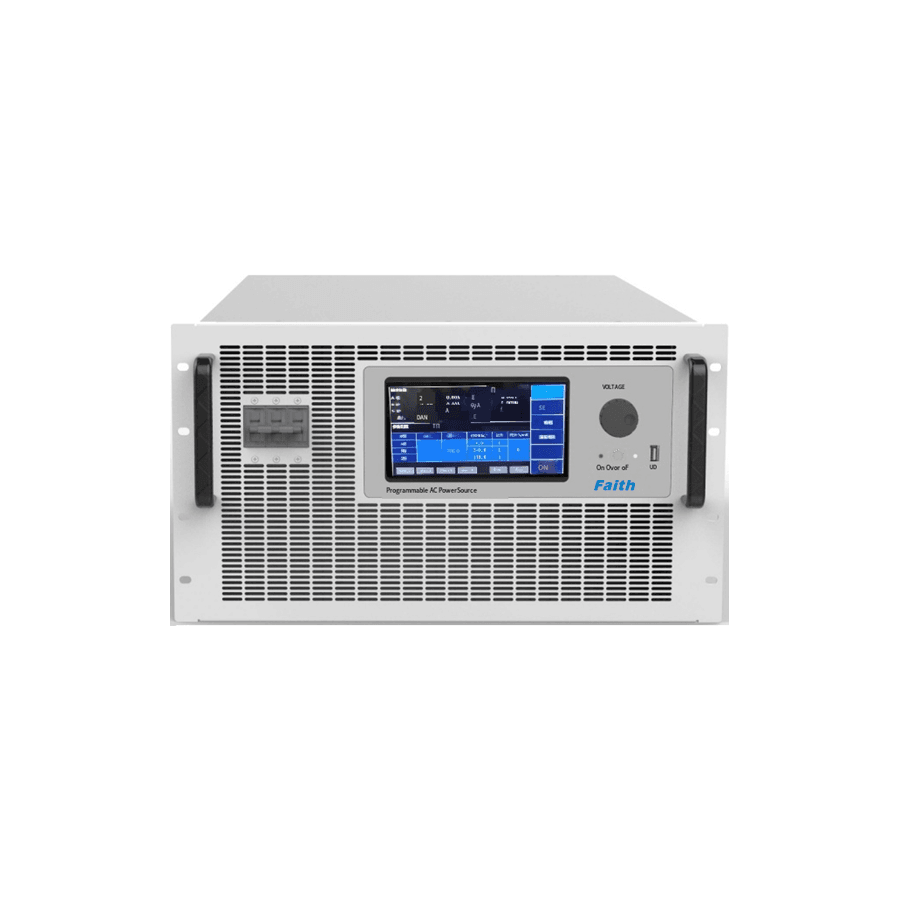
The FTPF Series Programmable AC power supply is engineered for applications requiring long-term stable AC power delivery. It is specifically suited for environments where devices undergo prolonged stress testing. In the LED field, the FTPF Series excels in driving LED components during comprehensive aging tests. Its robust design ensures that voltage and frequency remain stable, preventing fluctuations that could prematurely fail a device or skew test data.
Beyond LED drivers, the FTPF Series is highly effective in the communication field. It provides the necessary AC power output and supply for communication power supplies and communication electronic products undergoing testing and aging. Key application environments include:
For engineering teams focused on pushing devices to their limits through continuous, stable power input without the need for power recovery, the FTPF Series provides a reliable and straightforward solution for both home appliance durability experiments and communication electronics testing.

While standard programmable power supplies focus on delivering power, modern testing workflows increasingly require the absorption of power generated by the device under test. The FTPS Series operates as a bidirectional AC power supply and a regenerative grid simulator. This bidirectional capability makes it exceptionally valuable for testing communication electronic products and communication power supplies where energy flows back into the grid during specific test cycles.
The FTPS Series shines in the communication field by facilitating advanced testing and aging procedures. By simulating various grid conditions and safely routing regenerated power back to the facility grid, it enhances energy efficiency and reduces overall thermal load in testing environments. This is particularly advantageous in large-scale automated test fields and long-term durability experiments for home appliances.
Key applications for the FTPS Series include:
Choosing between the FTPF and FTPS Series requires a clear assessment of your testing objectives. If the primary goal is to provide uninterrupted, stable AC power for LED drivers and communication electronics during standard aging protocols, the FTPF Series delivers the necessary precision and longevity. It is the workhorse for production lines and aging rooms where consistent power application is the sole requirement.
Conversely, if your testing protocols involve regenerative loads—where the device under test generates power that must be safely dissipated or routed back into the grid—the FTPS Series is the superior choice. Its bidirectional nature and grid simulation capabilities provide a comprehensive testing environment for advanced communication electronics, aerospace components, and automated test systems. By matching the power supply's capabilities to the specific energy dynamics of the aging test, manufacturers can ensure product reliability while optimizing facility energy consumption.